
Christmas in Southern Europe vs Northern Europe
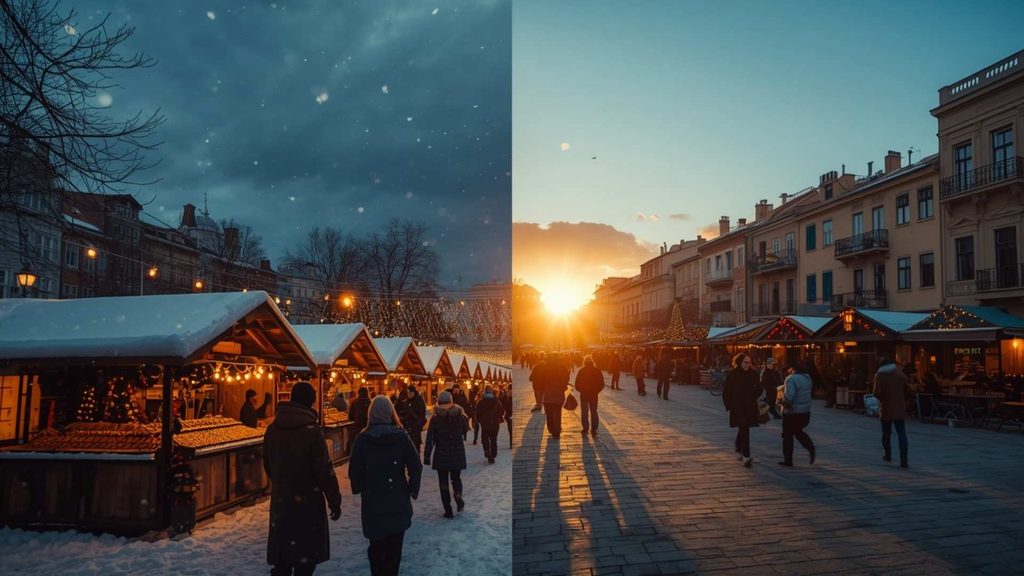
Europe at Christmas splits into two very different experiences. Head north and you find snow, darkness, and the kind of cold that makes a fire feel like a luxury. Head south and you find mild air, late sunsets, and celebrations that happen outdoors rather than beside a radiator.
Neither is better. But they suit different travellers, and choosing between them comes down to what you actually want from the season.
The Weather and the Light
This is the most obvious difference, and it shapes everything else.
In Northern Europe, December means short days and long nights. In Finnish Lapland, the sun barely rises at all, and the polar night creates a twilight that lasts for weeks. Temperatures drop well below freezing, sometimes to minus twenty or lower. Snow is reliable, especially in the far north, and the landscape becomes a white expanse that feels almost otherworldly.
In Southern Europe, December is mild. Daytime temperatures in Spain, Portugal, Italy, and Greece often sit between ten and eighteen degrees. Snow is rare outside the mountains. Daylight lasts longer, and while it is still winter, you can spend hours outdoors without needing to retreat to a café every twenty minutes.
The light matters more than people expect. Northern Europe in December is dark and atmospheric, which is exactly what makes the Christmas lights feel so dramatic. Southern Europe is brighter and softer, which makes the festive season feel less intense but more relaxed.
What Christmas Actually Looks Like
In the north, Christmas is an indoor affair. Markets are smaller and more concentrated, often built around a central square where people gather briefly before retreating to warmth. Food is heavy and warming: stews, roasted meats, mulled wine, and dense breads. The emphasis is on cosiness, on candles and fires and the pleasure of being inside while the cold presses against the windows.
In the south, Christmas spills outdoors. Markets are larger and more spread out, and the mild weather means people linger. Food is lighter, with seafood playing a central role in many countries. In Italy, the Feast of the Seven Fishes is a Christmas Eve tradition. In Spain, the main celebration happens on Christmas Eve with a long family meal, and the streets stay alive late into the night.
The traditions differ too. Northern Europe leans into the cosy, the candlelit, and the quiet. Southern Europe leans into the communal, the noisy, and the extended. Both are warm in their own way, but they feel completely different.
Snow and the Northern Lights
If snow is non-negotiable, Northern Europe is the safer bet. Lapland, northern Norway, Sweden, and Finland all but guarantee a white Christmas. The snow arrives in November and stays until April, and the landscape is transformed into something that feels like a storybook.
The north also offers the Northern Lights. From late August to early April, the aurora is visible on clear nights, and destinations like Tromsø, Abisko, and Rovaniemi are built around helping travellers see it. This is not a guarantee, but it is a possibility that Southern Europe simply cannot offer.
Southern Europe offers snow only in the mountains. The Alps and the Pyrenees have ski resorts and snowy villages, but the coast and the cities are mild and often sunny. If you want to combine Christmas markets with a walk on the beach, the south delivers. If you want to build a snowman outside your hotel, the north is where you go.
Cost and Crowds
Northern Europe is expensive, particularly in December. Accommodation in Lapland and the Norwegian fjords carries a premium, and the best properties sell out months in advance. Activities like husky safaris and Northern Lights tours add to the cost, though many packages bundle these together.
Southern Europe is generally more affordable. Spain, Portugal, and Greece offer good value for accommodation, food, and drink, especially outside the major cities. Even Italy, which can be pricey in the popular tourist destinations, has options at different levels.
Crowds vary too. The famous northern destinations like Rovaniemi and Tromsø are busy in December, but the smaller towns remain quieter. In the south, the big cities like Barcelona and Rome draw visitors, but the smaller towns and coastal areas are peaceful. Christmas in Southern Europe is less of a bucket-list event and more of a relaxed holiday.
Who Each Suits Best
Northern Europe suits: Families with young children who want the Santa experience. Travellers chasing the Northern Lights. Anyone who wants guaranteed snow. People who enjoy cosy indoor time and do not mind the cold. Those who are happy to pay a premium for a once-in-a-lifetime experience.
Southern Europe suits: Travellers who want mild weather and outdoor time. Couples seeking a romantic city break without the extreme cold. Anyone on a tighter budget. People who prefer seafood and late dinners to stews and early nights. Those who want a Christmas that feels communal and lively rather than quiet and cosy.
A Combined Approach
You do not have to choose. Some of the best Christmas trips combine both.
Start in a southern city like Lisbon or Seville, where the weather is mild and the festive atmosphere is relaxed. Then fly north to somewhere like Tromsø or Rovaniemi for a few days of snow, darkness, and the aurora. The contrast makes both experiences feel richer, and the travel between them is part of the adventure.
Another option is to base yourself in a central European city like Vienna or Munich, which offers the classic Christmas market experience, and then take a short trip into the Alps for snow. You get the best of both without committing fully to either.
The Verdict
Choose Northern Europe if you want snow, darkness, the aurora, and a Christmas that feels like a fairytale. Choose Southern Europe if you want mild weather, outdoor celebrations, good food, and a trip that feels relaxed rather than epic.
Both deliver a Christmas you will remember. The right choice depends on who you are travelling with, what you want to feel, and how much you are willing to spend to feel it.
Let Traavel Bug design your Christmas journey, whether it is a snowy northern escape or a mild southern celebration, with curated stays, private transfers, and festive experiences tailored to you.
📞 +91 72900 01545
Email: sm@traavelbug.com
Wherever your wanderlust takes you, Traavel Bug is here to craft the journey of a lifetime.